 Marques Jeevan Menon
The Reconstitutive Stewardship Economy
An economy rebuilt to last, where value is measured by resilience, trust and human capability.
A working answer to a question every institution now faces: what replaces a model built on extraction, when that model can no longer produce durable value?
One minute on rebuilding value
Sixty seconds, drawn in ink and narrated. Every word is also written on the screen as you listen, so it works with the sound on or off.
Read along: the words in the film
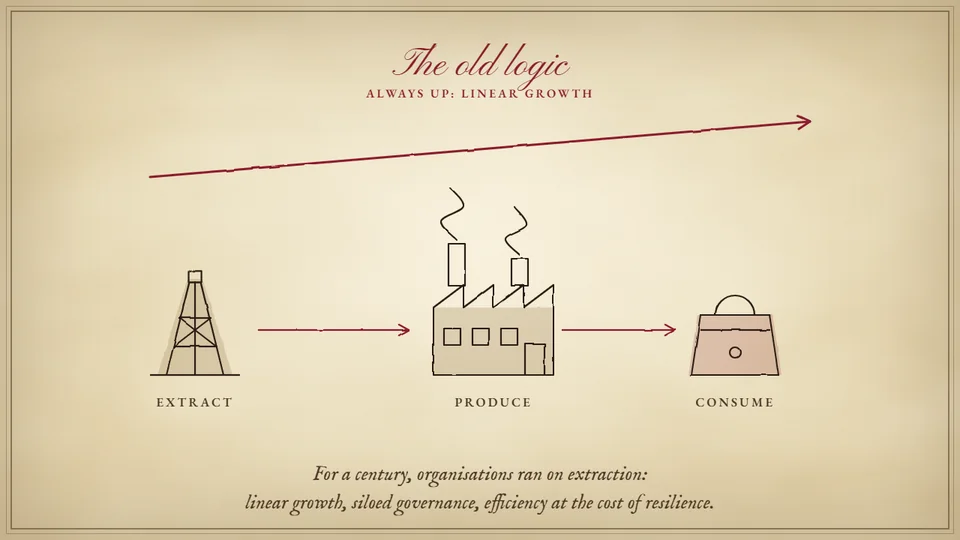
- The old logic
For a century, organisations ran on extraction:
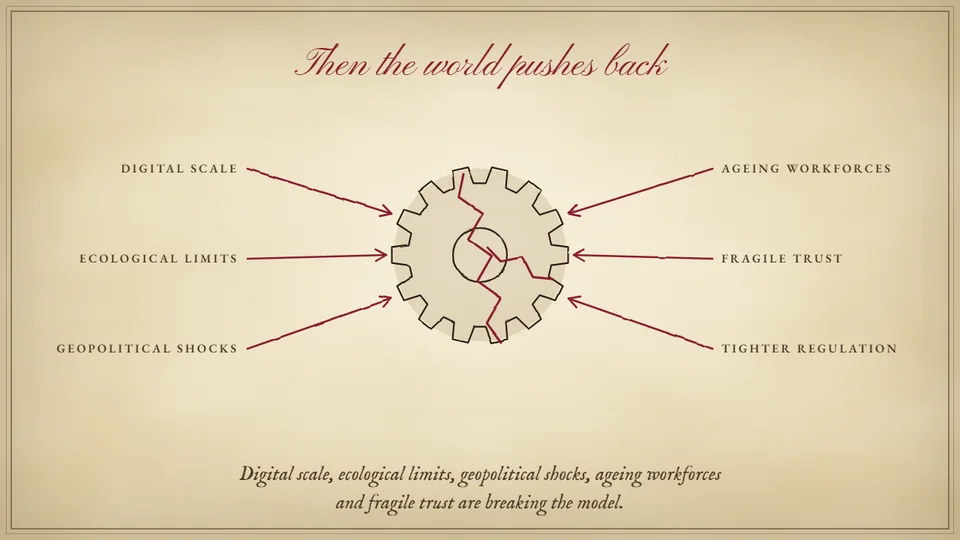
linear growth, siloed governance, efficiency at the cost of resilience. - Then the world pushes back
Digital scale, ecological limits, geopolitical shocks, ageing workforces
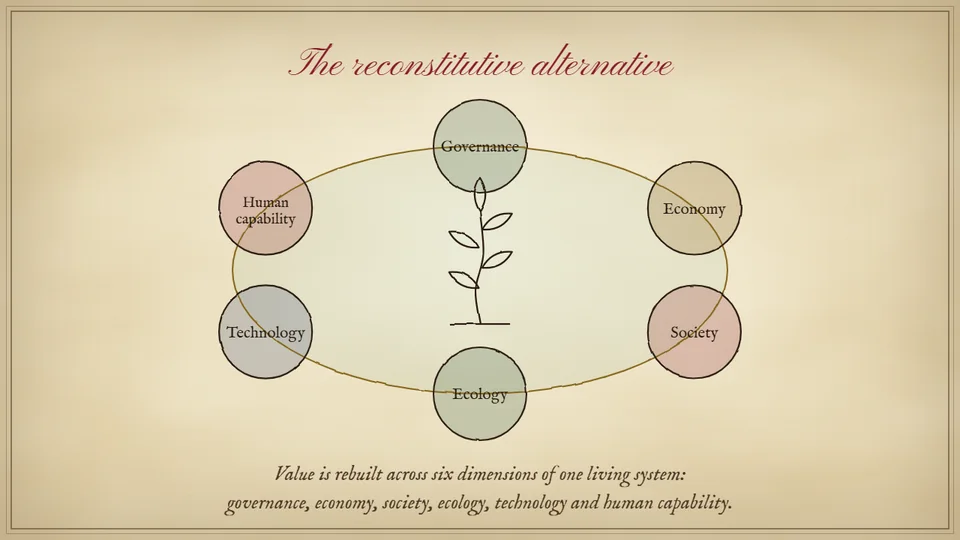
and fragile trust are breaking the model. - The reconstitutive alternative
Value is rebuilt across six dimensions of one living system:
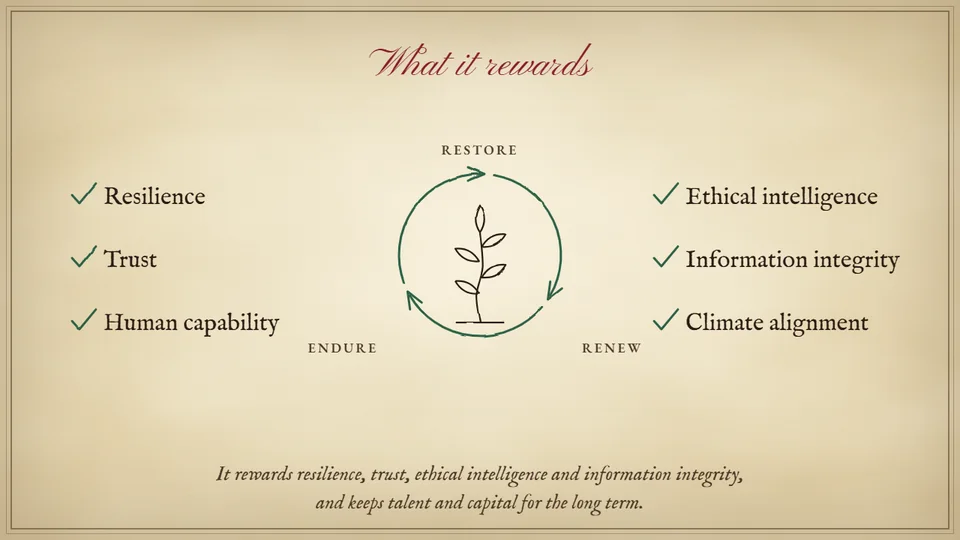
governance, economy, society, ecology, technology and human capability. - What it rewards
It rewards resilience, trust, ethical intelligence and information integrity,
and keeps talent and capital for the long term.
Reconstitutive Stewardship Economy, in plain words.
For most of the last century, organisations were built on what Marques calls the Industrial Extraction Paradigm: growth in a straight line, resources taken and consumed, governance split into silos, and efficiency chased even when it cost resilience. Value meant consumption, not longevity.
That operating logic is now failing. Digital scale has replaced industrial scale. Ecological limits, geopolitical volatility, ageing workforces, mobile talent, fragile market trust and tighter rules on data, climate and supply chains all press on the same point.
The Reconstitutive Stewardship Economy is his answer. It is an economy in which value is driven by resilience, trust, human capability, ethical intelligence, information integrity, climate alignment and adaptive ways of operating. It works across six dimensions of one living system: governance, economy, society, ecology, technology and human capability.
In it, trust is treated as infrastructure rather than a by-product, and leaders move from control-based authority to stewardship-based legitimacy. The claim is practical. Institutions built this way absorb shocks, keep their people, carry less regulatory risk, hold their customers longer and earn the confidence of investors who reward long-term stability.
Four moments from the film