 Marques Jeevan Menon
The Mosaic Threshold
A ratio for the moment a system spends more on show than it can regenerate.
A lens for reading the sustainability of an economy: how much of what a society produces is spent to be seen, and how much is invested to endure.
One minute on the tipping point
Sixty seconds, drawn in ink and narrated. Every word is also written on the screen as you listen, so it works with the sound on or off.
Read along: the words in the film
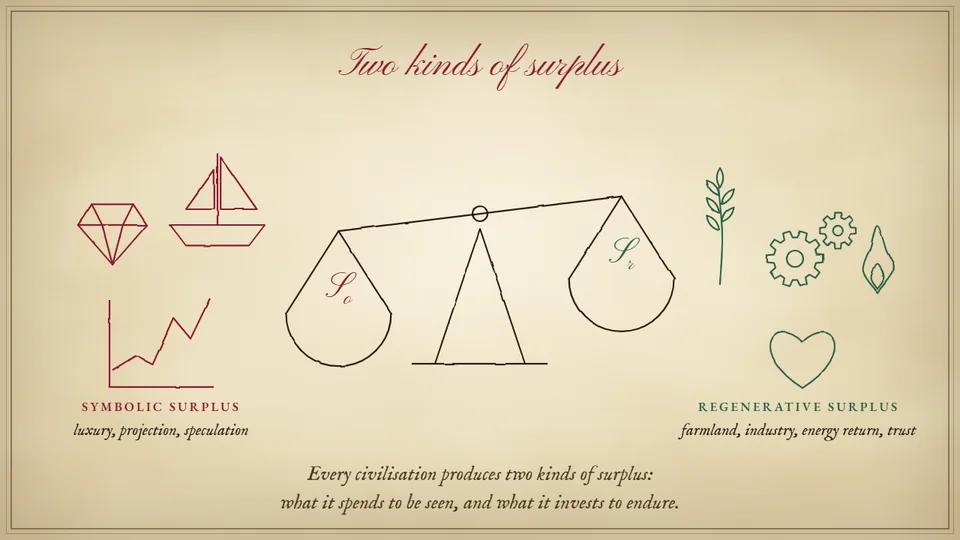
- Two kinds of surplus
Every civilisation produces two kinds of surplus:
what it spends to be seen, and what it invests to endure. - The ratio
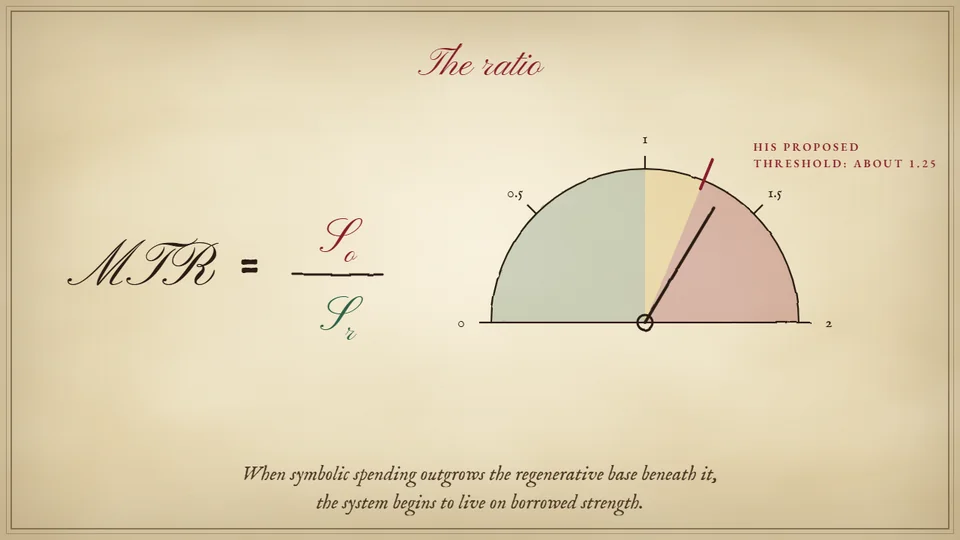
When symbolic spending outgrows the regenerative base beneath it,
the system begins to live on borrowed strength. - Past the threshold
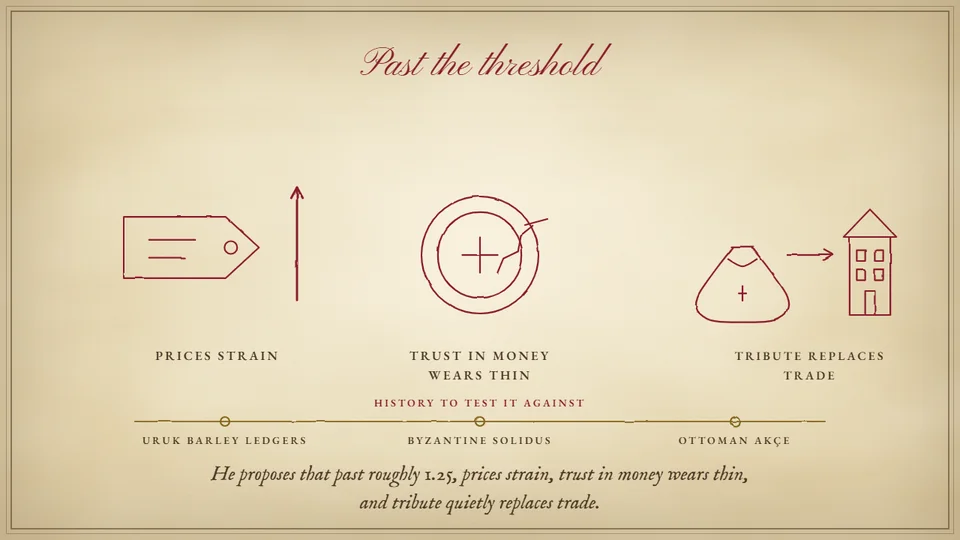
He proposes that past roughly 1.25, prices strain, trust in money wears thin,
and tribute quietly replaces trade. - A lens, not a law
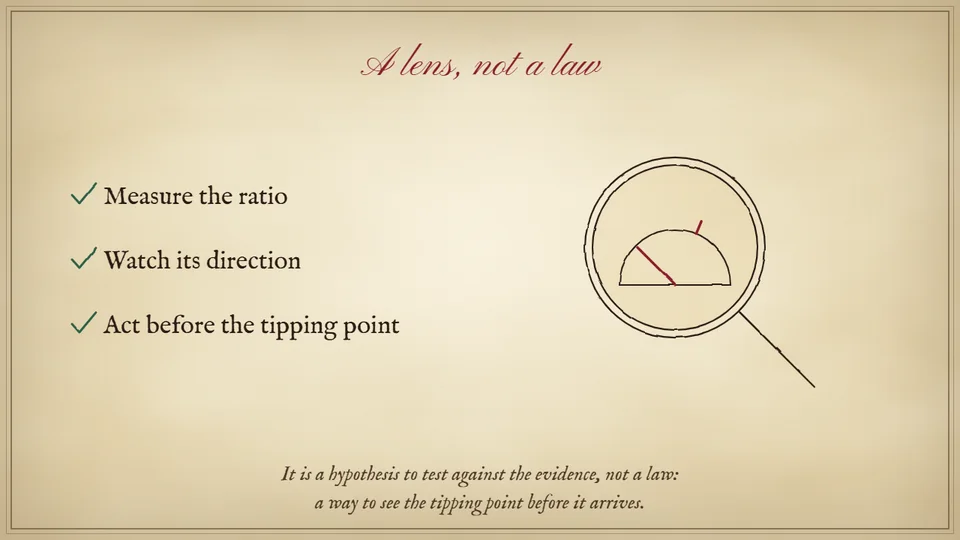
It is a hypothesis to test against the evidence, not a law:
a way to see the tipping point before it arrives.
The Mosaic Threshold, in plain words.
Every civilisation produces two kinds of surplus. Symbolic surplus is what it spends to be seen: luxury consumption, military projection, speculative capital. Regenerative surplus is what it invests to endure: farmland, industrial capacity, the energy returned on the energy invested, and trust.
The Mosaic Threshold is the ratio between the two: symbolic surplus divided by regenerative surplus, written MTR = So / Sr. It marks the point at which ornamental or symbolic spending outruns the regenerative capacity that sustains it.
Marques proposes a working threshold of about 1.25. Beyond it, he argues, structural inflationary pressure builds, trust in money wears thin and tribute mechanisms intensify. He points to Uruk's barley ledgers, the debasement of the Byzantine solidus, the adulteration of the Ottoman akçe and the debt-to-GDP ratios of late-stage economies as places to test the idea.
He offers it as a lens, not a law: a hypothesis to be tested against the evidence, and a way to see a tipping point before it arrives.
Four moments from the film
Six readings that sit beside the ratio
In his working notes the ratio never stands alone. It is read beside these six.
- Ornamental expenditure
- Resources directed toward prestige, speculation, symbolic consumption or low-regenerative spending.
- Regenerative surplus
- Resources that expand future productive, social, ecological or institutional capacity.
- Energy return (EROI)
- The net usable energy that supports the whole system.
- Ornamental entropy
- How widely ornamental behaviour has spread across sectors.
- Monetary dilution
- Debt, liquidity or monetary expansion used to sustain claims larger than the underlying surplus.
- Stability
- The institutional, monetary, social and political resilience of the system.
The other two ideas.
 One-minute film
The Reconstitutive Stewardship Economy
An economy rebuilt to last, where value is measured by resilience, trust and human capability.
Open the idea One-minute film
The AI Stewardship Framework
Who owns the intelligence, who gains from it, and who keeps the right to decide.
Open the idea